A Practical Guide to Australasian Louvre Requirements
If you work on projects across both Australia and New Zealand, you already know that specifying performance louvres in the two countries means dealing with overlapping standards, different compliance pathways and a surprising number of variables. The job of a louvre might be simple on paper – let air in and keep rain out – but getting to a compliant and reliable solution is not always straightforward.
The two countries share plenty of things like weather, rugby and a broad testing philosophy. But the way they interpret, enforce and apply their building codes can be quite different. That is where this guide helps. It gives you a clear explanation of the standards that matter in each region, how they relate to international tests, and what you need to consider so you choose the right louvre first time. It includes local nuance, real project context, and practical steps you can apply straight away.
Step 1: Start with the regulatory foundations
Louvres sit at the overlap of ventilation, external moisture, mechanical design, structure, fire behaviour and energy efficiency. Because they cross so many boundaries, you will rarely find a single tidy answer in one document. The best starting point is the governing building code for each country.
New Zealand – NZ Building Code (NZBC)
Compliance in New Zealand is usually demonstrated through Acceptable Solutions, Verification Methods or Alternative Solutions. For louvres, the relevant clauses include the following.
G4 - Ventilation. This clause ensures sufficient supply of outdoor air to interior spaces. In complying with G4, louvres can be used as both passive / natural ventilators on their own, or as part of a mechanical ventilation system. When being used as a passive ventilator, louvres are often sized so they are 5% of the floor area of the space being ventilated. It's important to note that this dimension applies to the face area of the louvre and not the free area.
E2 - External Moisture. E2 does not prescribe a specific test method or specifically address ventilation louvres. However, the council and building consent authorities generally request evidence that the louvres will prevent water from entering the building, and that any water carryover that does occur is suitably managed and drained back to the outside.
H1 - Energy Efficiency. Unfortunately, this clause is often overlooked, but as time goes on energy efficiency is becoming increasingly important. H1 sets maximum pressure loss for different types of louvres and is designed to ensure that the fan efficiency of mechanical ventilation systems is not exceeded. Higher pressure loss through a louvre = more energy consumed by the fans, and thus higher operation carbon.
B1/B2 - Structure & Durability. Structural design must confirm the louvre can resist wind loads, live loads and seismic actions. Compliance with B1 and B2 is generally demonstrated via a Producer Statement (PS1) and supporting calculation issued by a certified structural engineer.
C/AS2 - Fire. If the louvre penetrates a fire separation or forms part of a smoke control path, additional fire performance requirements may apply. Louvres cannot compromise containment or evacuation routes.
Australia – National Construction Code (NCC)
The NCC works in a similar way but reflects Australia's wider climate conditions and regional risks. Louvre related requirements appear in Sections F and J, along with standards such as AS:3959.
Section F. This section sets the minimum requirements for how much outdoor air must be distributed through the building. Louvres within the ventilation pathways must comply with allowing enough airflow throughout the building.
Section J. Similar to the New Zealand code clause H1, Section J requires that louvres meet overall energy efficiency requirements for the building, including maximum pressure losses, airtightness of façade integration and thermal performance.
AS:3959 (Bushfire Construction). Applies in bushfire prone areas. Depending on the BAL rating, louvres may require ember resisting mesh, non-combustible construction or specific detailing. Ventüer provides BAL compliant mesh options across al louvre systems.
Because Australia spans everything from alpine zones to cyclone regions, compliance can look very different from state to state. Getting the selection right often means understanding local conditions before anything else.
Step 2: Understanding the major test standards
Across the world, three test standards dominate performance louvre testing:
• BS EN 13030 (Europe)
• AS NZS 4740 (Australasia)
• AMCA 500 L (North America)
These tests are sometimes described as incomparable, but in reality, they measure similar attributes, water penetration, airflow resistance, and pressure loss. Each uses different test rigs and classifications, which means results should not be directly substituted, but the intent is the same: to give designers reliable, repeatable data they can trust.
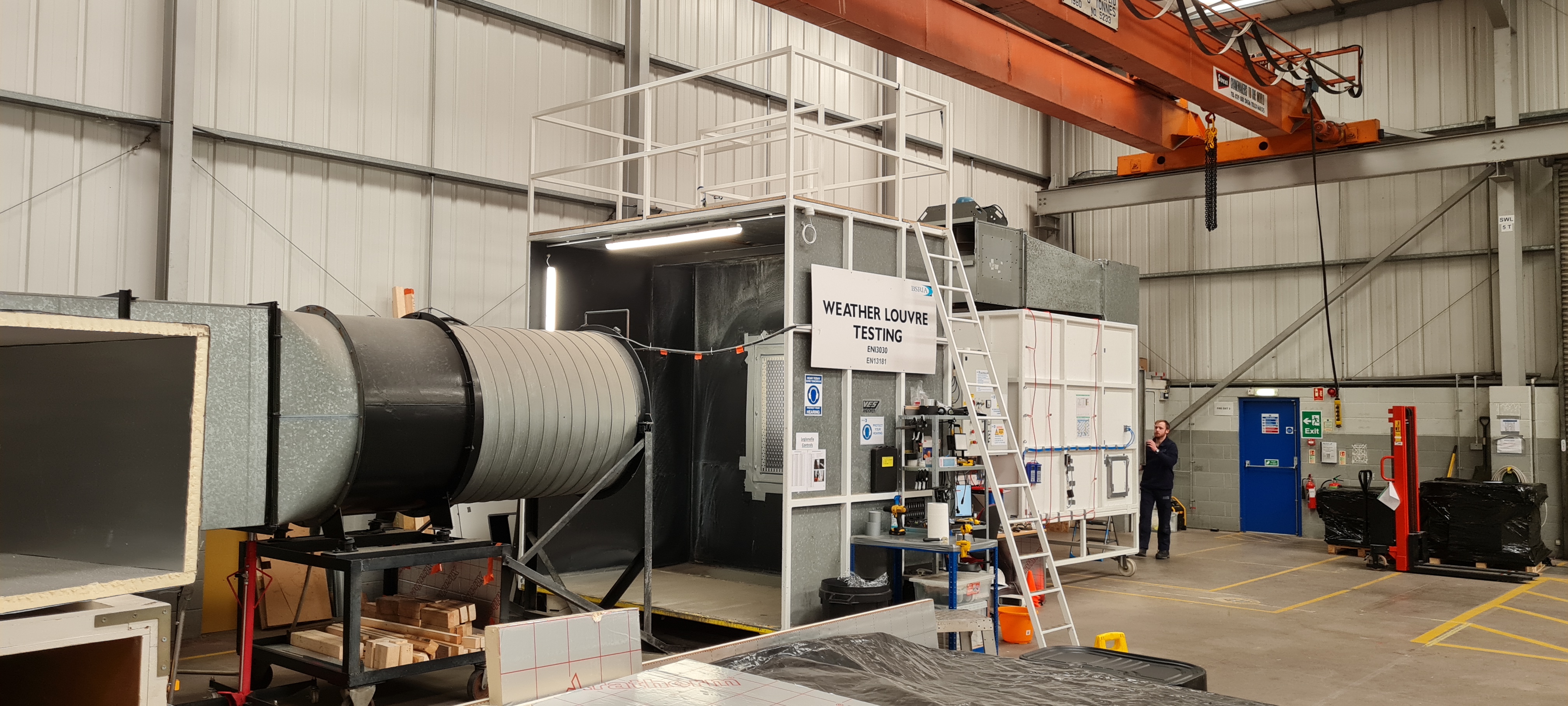
BS/EN:13030 is widely used for weather louvre performance globally. It measures water penetration at a range of airflow rates, pressure loss characteristics, and assigns an overall classification from A to D. The test simulates driving rain at 75 mm/hr combined with simulated wind at 13 m/s. Intake airflow is varied from 0m/s to 3.5m/s, and the resultant water carryover is measured at 0.5m/s increments. Ventüer are transparent about the louvre testing methods that are undertaken and all our BS/EN:13030 test reports are all available on our website, sharing the measurements recorded and overall classification for each louvre.
AS/NZS:4740 is the local Australia / New Zealand louvre test standard which has been predominantly based upon the BS/EN:13030 criteria. In 2025 this standard was updated to correct previous inaccuracies in data recording methodology, and to include higher wind speeds and simulated rainfall levels.
AMCA:500-L is primarily used in by louvre manufacturers and specifiers in North America. It shares much of the test criteria with BS/EN:13030 and AS/NZS:4740, however also includes a “still air test”, where rainfall dropped in front of the louvre and an intake fan behind draws air in (with no external “wind” pressure).
Together, these standards form a global foundation for local compliance, and once you understand how each one tests performance, it becomes clearer why councils, engineers and designers specify certain requirements. A key point is that designers should only compare results within the same standard, even though all three aim to answer the same overall question. They are not contradictory, but they are not interchangeable either. BS/EN:13030 is often regarded as the most consistent and reliable of the three because its strict, highly controlled test environment produces repeatable data that designers can trust.
Step 3: Wind, seismic and impact loads
Environmental loading is one of the biggest factors in determining whether a louvre is suitable for a project. Even a high performing weather louvre can fail if it cannot withstand the structural forces acting on it, so this stage of selection needs careful attention early in the design process.
New Zealand
New Zealand projects are heavily influenced by wind and seismic conditions. Many regions sit within severe or very high wind zones, and the presence of hills, escarpments and coastal sites often introduces topographical amplification. These effects can significantly increase wind pressure on the building envelope and therefore on the louvre system. On top of this, seismic actions introduce inter storey drift, which means the structure can move laterally during an earthquake. Louvres installed across floor levels or fixed between rigid elements must be able to accommodate this movement without buckling, binding or detaching. This is where fixings, allowable spans, mullion reinforcement and tolerance for deformation become critical. In many cases, the mounting substrate is the limiting factor, so understanding its capacity early avoids redesigns later on.
Australia
Australia faces its own set of environmental challenges. Many regions in northern and coastal Australia are categorised as cyclonic zones, where wind pressures can far exceed those seen in most of New Zealand. Even non cyclonic regions often have high category wind demands depending on building height and exposure. Certain industrial or cyclone prone areas may also require consideration of impact loads or fatigue loads, particularly where airborne debris is a risk. These loads influence blade thickness, frame robustness, fixing density and overall louvre configuration. As a result, a louvre that is perfectly suitable in Melbourne or Adelaide may be entirely unsuitable in Townsville or Darwin without significant engineering adaptation.
Both countries rely on the AS NZS 1170 series for wind and structural load calculations, but the actual design pressures can vary dramatically depending on the region, terrain category, building height and risk factors. This makes it essential to involve the louvre manufacturer or engineer early in the design. The most reliable approach is to request allowable spans at concept stage, confirm the fixing patterns and the substrate strength, and ensure the design allows for movement where seismic drift applies. Doing this upfront avoids costly redesigns, improves coordination across disciplines and ensures the selected louvre has the structural integrity to perform safely throughout its life.
Step 4: Fire, smoke and façade performance
Fire performance is a common area of confusion. Louvres cannot pass or fail tests like BS:8414 on their own. Instead, its role is assessed as part of the entire wall build up, and its suitability depends on how it interacts with the other materials around it.
For smoke control applications, the relevant benchmark is EN 12101 2, which outlines the requirements for smoke ventilators. This includes the aerodynamic free area, how reliably the device opens under emergency conditions, its resistance to heat exposure and its ability to operate under load. Even if a louvre or ventilator meets international standards like this, it still needs to be reviewed by the project’s fire engineer in New Zealand or Australia to confirm it aligns with the local fire strategy. This is because smoke control, compartmentation and escape routes are designed holistically, not product by product.
Fire requirements in Australia can be driven by both traditional fire engineering and the bushfire regulations under AS 3959. In bushfire prone regions, louvres may need ember resisting mesh, non-combustible materials, metal only construction and the elimination of any plastic components that could melt or ignite. These measures are designed to stop burning embers from entering the building during a bushfire and are mandatory at certain BAL ratings.
Step 5: Bringing it all together!
The following 10-Point plan will set you up for successful specification on your next project:
1. Confirm the required airflow rates for the space.
2. Establish the maximum acceptable pressure loss.
3. Define the permissible level of water carryover.
4. Identify any acoustic, fire or smoke performance requirements.
5. Determine the site wind loads based on location and height.
6. Confirm seismic demands or interstorey movement requirements.
7. Identify the bushfire zone classification if the project is in Australia.
8. Review the building code clauses and performance standards that apply.
9. Check that your louvre supplier provides independent, verified test data.
10. Choose a supplier who can complete project specific calculations and engineering checks.
Some common mistakes to avoid
There are many common pitfalls that can compromise both performance and compliance. One of the most frequent mistakes is comparing test results from different standards, as if they are identical. As previously mentioned, international standards serve similar purpose but treating them as identical can lead to selecting an underperforming louvre.
Another common error is choosing louvres based on solely free area. While free area is always important, it doesn't always capture real-world airflow or pressure behaviour. Relying on this metric alone can result in undersized or inefficient systems.
Some also assume that louvres provide primary weather protection. In reality, they are secondary protection only and expecting them to stop water ingress entirely often leads to leaks and disappointing performance.
Conclusion
While New Zealand and Australia share many standards, they are applied differently depending on climate, location, and building type. Louvres need to balance ventilation, weather protection, structural integrity, energy efficiency and fire safety all at one. That's a complex task at the best of times, which is why selecting the right product is more than just picking one off the shelf. That's where Ventüer comes in. With transparent testing data, engineering documentation, and specialist guidance tailored to each region globally, we are here to ensure the product selected performs reliably, efficiently, and safely.