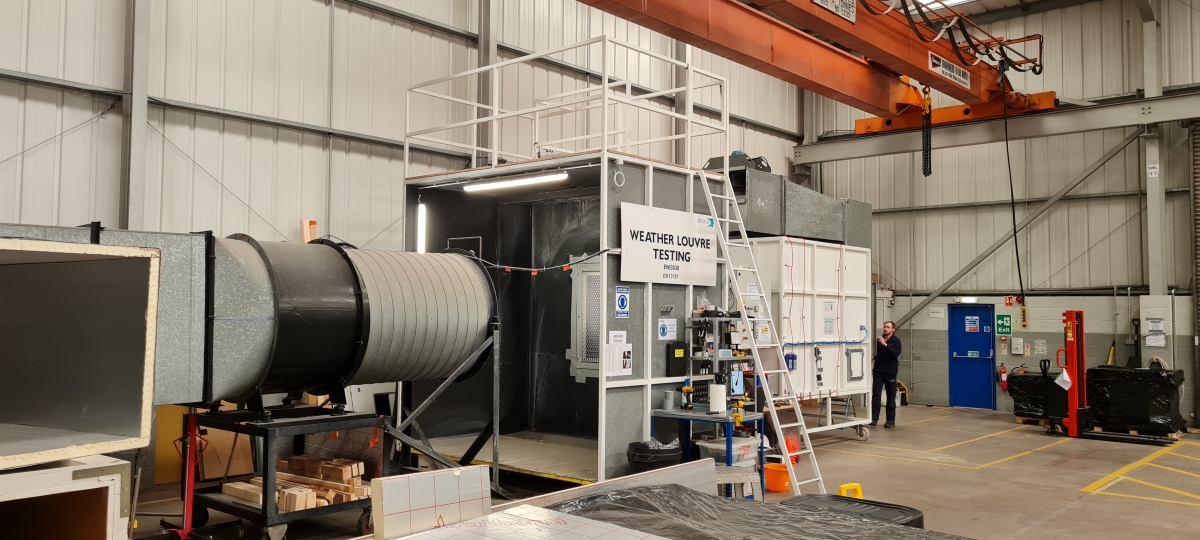
When comparing louvre performance, you may come across two testing standards: AS/NZS 4740 and BS EN 13030. Both are used to assess important aspects of louvre performance, including airflow, pressure drop and resistance to water penetetration.
But what is the difference between them, and can their results be directly compared?
How Do the Standards Differ?
AS/NZS 4740 is the Australasian standard for louvre performance testing and is broadly based on the European standard BS EN 13030.
While both standards assess the same performance characteristics, they differ in how testing is carried out. These differences include test equipment configuration, calibration procedures and the methods used to collect performance data.
As a result, the two standards are not directly interchangeable, and the same louvre could achieve different results depending on which testing method is used.
Which Standard Is More Reliable?
One of the key differences ins the consistency and repeatability of testing.
BS EN 13030 uses more rigorous procedures for equipment calibration, airflow measurement and water penetration testing. These methods are designed to produce consistent results, making it easier to compare the performance of different louvre systems.
By comparison, AS/NZS 4740 has limitations in its calibration and data collection methods. These can introduce variations between testing facilities and affect how accurately results represent real-world performance.
What Does This Mean When Specifying Louvres?
When comparing louvre products, it's important to check which standard the performance data has been tested against.
Although AS/NZS 4740 has historically provided a local benchmark, Ventuer recommends BS EN 13030 as a more reliable basis for comparing louvre performance, particularly where accurate, repeatable and internationally comparable test results are required.
Ultimately, understanding the testing standard behind the published performance data helps ensure louvres are assessed on a consistent basis and selected to meet the requirements of the project.